Christian Centre Academy in Saskatoon (later renamed Legacy Christian Academy in 2013, and then Valour Academy in 2024) is, for many years, a private Christian school tied closely to Saskatoon Christian Centre church (then later Mile Two church, and now Encounter Church). What former students have described, and what has been documented in news reporting, court filings, and police investigations, paints a picture of a tightly controlled, insular environment where religion, authority, discipline, and schooling were deeply fused together.

Pastor Keith Johnson (right) poses in front of a billboard advertising Saskatoon Christian Centre in the early 1980’s.
Christian Centre Academy opened in 1982, founded by Pastor Keith Johnson, operating out of the same building as the Saskatoon Christian Centre. From its early beginnings, the school was closely tied to the church community, sharing both space and leadership under the same roof. The arrangement reflected a broader model of integrated church-based education at the time, where religious instruction and academic programming were delivered within a unified environment rather than as separate institutions.
Below is a detailed, factual overview based on publicly reported allegations, the statement of claim, affidavits, and accounts from former students.
What the school was like day to day

Saskatoon Christian Centre and Christian Centre Academy shared the same building on 102 Pinehouse Drive in Saskatoon, Saskatchewan. Photo taken 2012.
Day-to-day life at the school, as described by former students, followed a rigid, almost mechanical rhythm where structure wasn’t just encouraged – it was enforced at nearly every moment. Classrooms were often quiet to the point of tension, with students working independently in partitioned desks that limited interaction and kept focus tightly controlled. Movement, conversation, and even small deviations from expected behaviour could draw attention, creating an environment where students became hyper-aware of their actions. Even having to go to the washroom was strictly controlled and subject to disciplinary measures.
Students describe learning early that compliance was not just about following rules, but about aligning outward behaviour with internal belief. The result, many say, was a constant pressure to self-monitor – what you said, how you said it, even what you appeared to think.
This structure didn’t end when the school day did. Because of the close integration with the church, the same authority figures, values, and expectations carried into evenings and weekends, blurring the line between school, home, and spiritual life. For some, this created a sense that there was no real “off switch” – no space where they could simply be themselves without scrutiny.
Within that environment, former students often describe fear as a quiet but constant presence. Not always loud or visible, but woven into routines, reinforced through discipline, and sustained by uncertainty about consequences. Over time, many say, it shaped how they interacted with others, how they viewed authority, and how safe it felt to question anything at all. It was described as “a culture of fear”.
Strict control and isolation
Former students describe an environment where control was built into both the physical space and the social fabric of daily life. In the classroom, this often meant working alone for long stretches in partitioned, cubicle-style desks designed to limit eye contact, conversation, and collaboration. The layout itself reinforced a sense of separation, where interaction wasn’t just uncommon – it was discouraged or, at times, treated as a rule violation. Students say this reduced opportunities to form natural peer connections and made the classroom feel more like a monitored workspace than a typical learning environment.
This structure extended into how relationships were formed and maintained. Former students report that friendships were closely observed, and in some cases influenced or restricted based on perceived spiritual alignment. Associations with peers or individuals outside the school or church community could be discouraged if they were seen as conflicting with expected beliefs or behaviours. Over time, this reportedly created a social environment where acceptance was tied to conformity, and where students became cautious about who they connected with and how openly they did so.
Accounts also describe broader practices of separation that went beyond students themselves. Some families were reportedly distanced or cut off from the community through forms of ex-communication or shunning, which would involve losing social ties not only within the church but also within the school. For students, this could mean sudden changes in their social world – friends no longer accessible, relationships abruptly ended, and a strong message about the consequences of stepping outside accepted norms.
Taken together, these descriptions point to a system where isolation was not only physical but social and emotional as well – limiting interaction, shaping relationships, and reinforcing a controlled environment that extended far beyond the classroom walls.
Education style and discipline system
The education style and discipline system described by former students was built around a highly structured, self-paced model that relied heavily on standardized workbooks and strict behavioural expectations. Central to this approach was the Accelerated Christian Education (A.C.E.) curriculum, a U.S.-originated program developed in the 1970s that organizes learning into sequenced modules called PACEs. Students worked through these materials individually, progressing step by step, with frequent testing and self-correction built directly into the system.
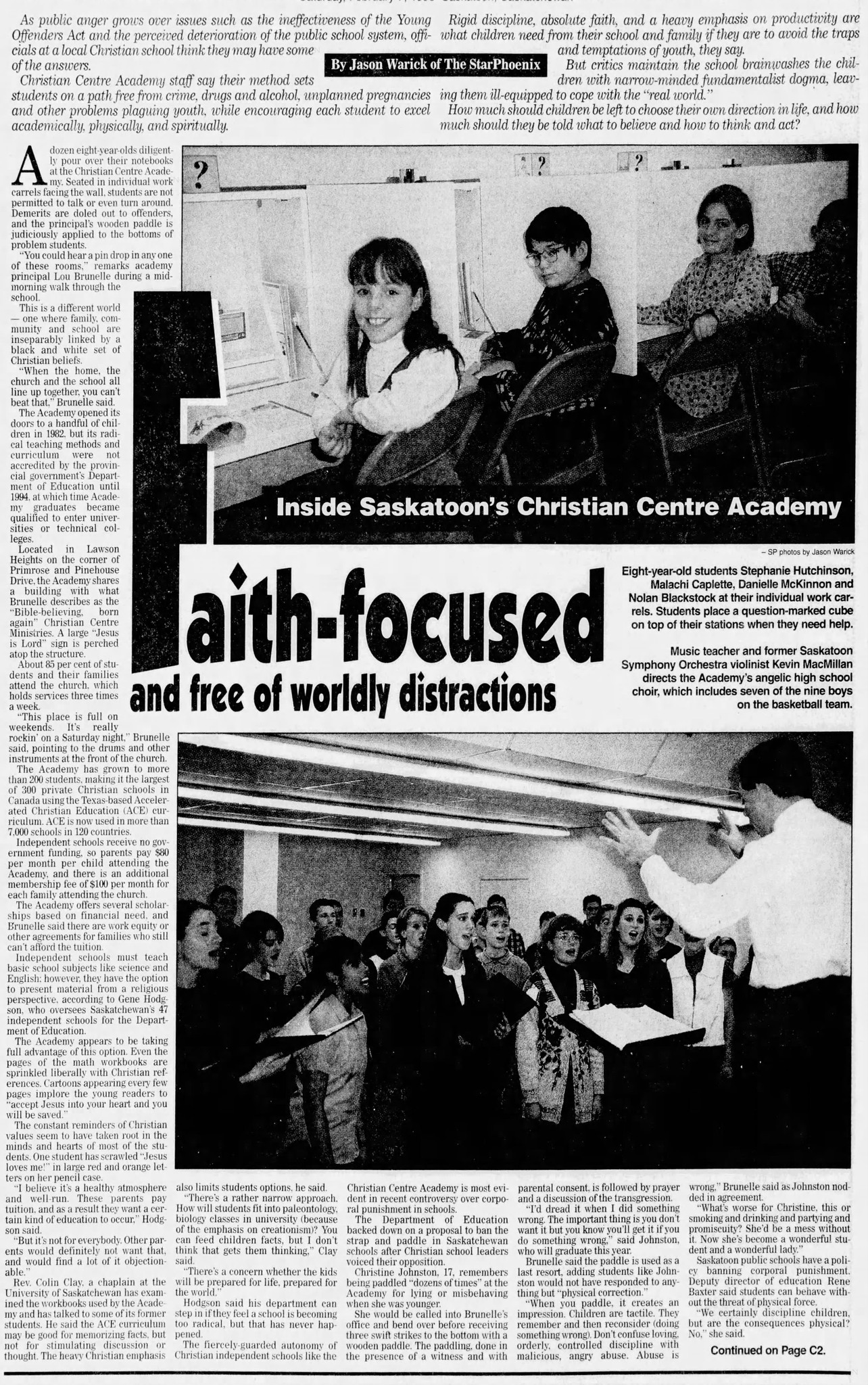
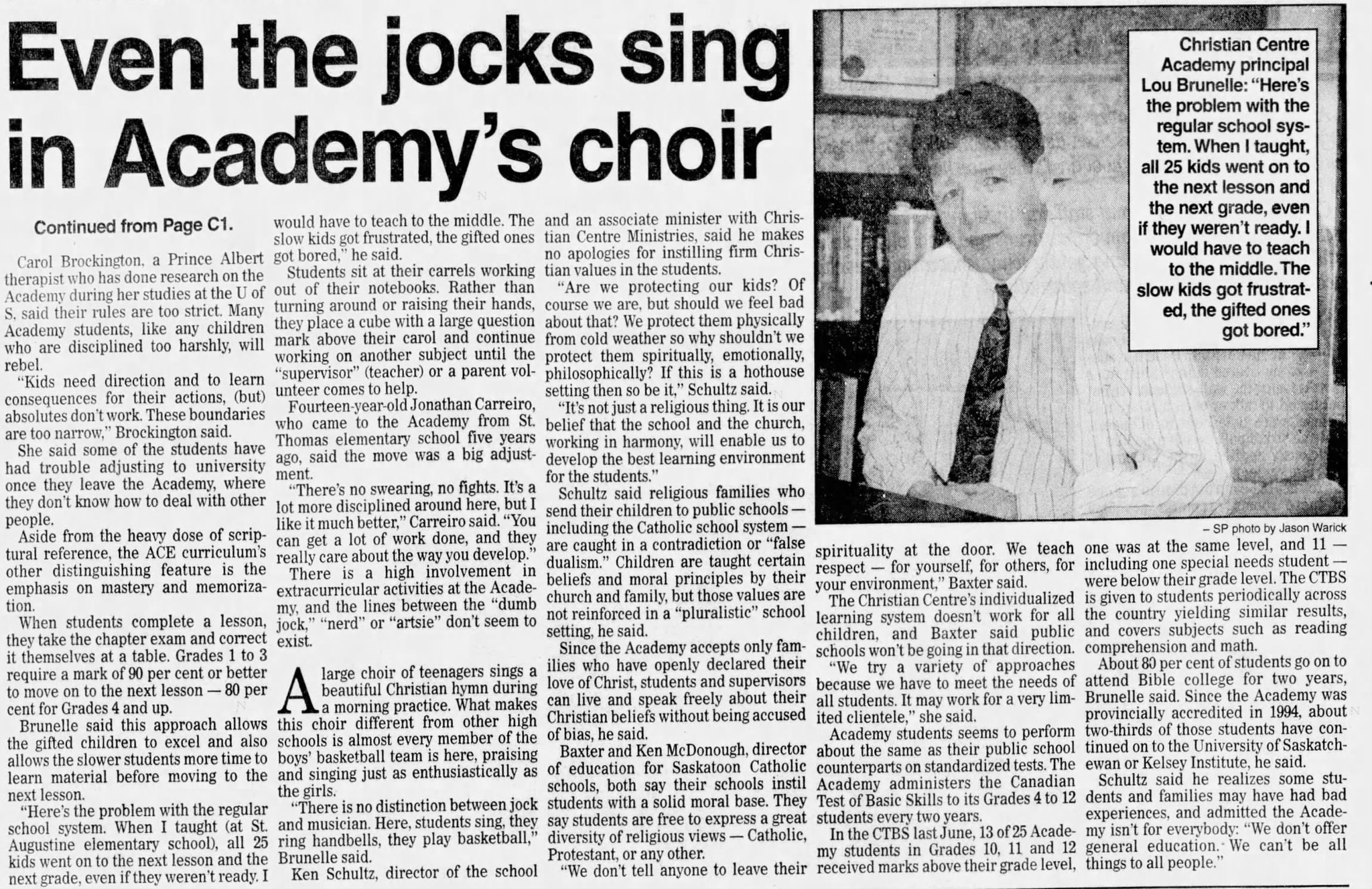
In practice, students describe a classroom environment where independent work was constant and tightly regulated. They would complete assignments, check their own answers, and have their work reviewed under close supervision. While the system emphasized personal responsibility and discipline, former students report that it also created a strong sense of surveillance around performance. Mistakes were not simply treated as learning opportunities but could be interpreted as failures of effort, honesty, or character, depending on the context and interpretation of staff.
Discipline within this framework was closely tied to academic performance and behavioural compliance. Reports from former students describe a system in which errors in coursework, repeated mistakes, or perceived insubordination could escalate beyond academic correction into disciplinary action. In some accounts, this included demerits, being removed from class or sent to administrators for further consequences. These consequences, according to multiple allegations, sometimes involved physical punishment, including corporal discipline such as paddling.
Critics of the A.C.E. system more broadly argue that its structure can limit collaborative learning and critical thinking by emphasizing rote progression, self-checking, and strict adherence to predefined answers. In the context described by former students, these structural features were further intensified by the school’s disciplinary culture, where academic mistakes and behavioural expectations were closely intertwined, creating an environment where learning and discipline were difficult to separate.
Overall, the system described by former students functioned not only as an educational framework but also as a behavioural structure, where academic progress, moral conduct, and disciplinary consequences were tightly linked within a single, highly controlled learning environment.
Demerits and “privileges”
In most implementations of the A.C.E. system and in schools that used it, like this school, the demerit and privilege structure could escalate into more serious disciplinary consequences depending on how rules were enforced locally. While A.C.E. itself is a curriculum framework, not a disciplinary policy, schools using it often layered their own behaviour systems on top of it.
In practice, this meant that accumulating demerits or repeated violations of rules could trigger a step-up in consequences. Early stages typically involved loss of privileges, increased supervision, or additional corrective work. However, in stricter environments described by former students, continued infractions or what were interpreted as serious behavioural issues could lead to referral to administrators or discipline authorities within the school.

Actual examples of demerits received for minor infractions such as not owning a baseball glove or needing to use the washroom.
From there, some former students allege that discipline escalated further into corporal punishment, including paddling. In these accounts, physical discipline was framed as a corrective measure for ongoing disobedience, repeated rule-breaking, or what staff interpreted as defiance or lack of respect. The decision to escalate from demerits to physical punishment was not part of the core A.C.E. curriculum itself, but rather part of how some schools operationalized discipline within their own internal policies.
In this way, the demerit and privilege system functioned as a structured pathway for behavioural correction, where minor infractions could accumulate into more significant consequences. In the most restrictive environments described by former students, that escalation pathway could ultimately include corporal punishment, making the system feel tightly linked from everyday classroom behaviour all the way through to physical discipline.
Religious integration
Religious instruction wasn’t treated as a discrete subject with a clear beginning and end bell. Instead, it functioned like a continuous operating system running underneath the entire school environment, shaping expectations from the moment students arrived until long after the day was officially over. Routines, classroom behaviour, lunch, recess, and end-of-day all carried the same underlying current: that religion was not something you practiced at specific times, but something that governed how you thought, spoke, and responded at all times.
The reach of that structure extended well beyond classroom hours. Evenings and weekends were often still framed through the same behavioural and spiritual lens, especially for students whose social circles and family connections were closely tied to the same church environment. This created a setting where there was limited conceptual separation between “school life” and “life outside school.” Expectations followed students home, not always through formal instruction, but through reinforced norms about obedience, conduct, and spiritual alignment.
Within that system, spiritual compliance and behavioural obedience were closely intertwined. Following rules was not just about discipline in an educational sense; it was framed as evidence of moral and spiritual correctness. Conversely, questioning instructions, policies, or doctrinal interpretations could be interpreted as resistance not only to authority, but to the belief system itself. That framing carried significant weight. It meant that disagreement was not neutral—it could be recast as disobedience in both behavioural and spiritual terms, increasing the pressure to conform and narrowing the space for open questioning.
Students describe how this dynamic shaped peer relationships and social standing. Approval was often linked to visible conformity, and deviation from expected behaviour could lead to exclusion, distancing, or formal discipline. In such an environment, belonging was closely tied to compliance, and social acceptance could become contingent on adherence to both written rules and unwritten expectations.
The physical layout of the institution reinforced this unity. The church and school shared a wall and operated within the same building at 102 Pinehouse Drive. This was not just a matter of convenience; it symbolically and practically collapsed the boundary between worship space and educational space. Movement between church and school areas did not represent a transition between separate institutions, but rather shifts within a single, unified environment.
Institutionally, that unity extended to staffing and governance. School personnel were members of the church in good standing, meaning that employment, leadership, and spiritual participation were deeply interconnected. Authority in the classroom and authority in the church were not separate streams; they flowed from the same organizational source. As a result, oversight mechanisms that might normally exist between an educational institution and an external religious body were effectively internalized within a single structure. An elder of the church, Ken Schultz was also director of the school.
Financial and operational systems reflected the same integration. Resources, decision-making, and institutional priorities were not divided between two independent entities, but managed as part of a shared ecosystem. The school was not merely influenced by the church’s doctrine; it functioned as an extension of it, with educational practice shaped by the same theological framework that governed church life.
In this context, the doctrines taught in the church were not only reinforced in the school curriculum but also expressed through disciplinary practices, including corporal punishment. Discipline was framed within a moral and spiritual rationale, aligning behavioural correction with religious instruction. Over time, this created a tightly coupled system in which theology, education, authority, and discipline were not parallel structures, but interlocking parts of a single institutional whole.
Allegations of abuse and violence
The allegations of abuse and violence form one of the most serious and heavily scrutinized aspects of the school’s history, emerging over time through former student testimonies, investigative journalism, and legal filings. These accounts describe patterns of conduct that go beyond strict discipline, pointing instead to instances where authority may have been exercised in ways that caused harm. It is essential to approach this subject with care and precision: many allegations have been brought forward and investigated, some remain before the courts, and others have already resulted in criminal convictions.
Reports of physical punishment are among the most consistently described, with former students alleging the use of corporal discipline that, in some cases, crossed into physical assault. Multiple individuals have come forward with similar accounts, which has contributed to police investigations and formal complaints. In parallel, there have been allegations of sexual misconduct involving staff or individuals connected to the institution. Some of these cases have been tested in court and have led to guilty verdicts and sentencing, confirming that certain abuses did occur.
What gives weight to the broader body of allegations is not just the number of accounts, but their recurring themes across different time periods and individuals who did not necessarily know one another. These patterns have been examined in civil proceedings, including a proposed class-action lawsuit, where plaintiffs argue that the environment and structure of the institution enabled or failed to prevent harm.
At the same time, other allegations remain unproven in court, and legal processes are ongoing. Police investigations into historical complaints have spanned years, reflecting both the complexity of the cases and the challenges involved in addressing events that may have occurred decades earlier. The result is a situation where confirmed findings of abuse exist alongside unresolved claims still moving through the legal system.
Taken together, these developments have shifted the issue from isolated accusations to a broader public and legal examination of the institution’s past, its systems of authority, and the responsibilities of those in positions of power.
Corporal punishment (paddling)
Corporal punishment, particularly the use of a wooden paddle, is one of the most frequently cited and emotionally charged allegations described by former students. Accounts suggest that this form of discipline was not rare or exceptional, but in some periods and settings, a normalized response to a range of perceived infractions. Students describe being called in for punishment after classroom issues or behavioural concerns, sometimes with little warning and in a highly formalized, procedural manner.
The reasons given for paddling, according to former students, were often not limited to serious misconduct. Instead, reports include disciplinary action for relatively minor classroom issues such as incorrect answers that were interpreted as careless, failure to follow expected procedures in self-marked work, or perceived lack of respect in tone or attitude. Behaviour outside of academics, including conduct during school or church-related activities, is also cited in allegations as a trigger for punishment. Over time, students describe learning to associate even small mistakes with the possibility of physical discipline, which contributed to heightened anxiety around everyday school tasks.

Actual example of a ‘personal services record’ detailing the dates and reasons given for corporal punishment or paddlings.
Descriptions of the punishment itself vary, but many accounts reference the use of a wooden paddle administered by staff in authority positions. Some former students allege that these incidents resulted in visible marks, bruising, or lingering physical discomfort. Others emphasize the emotional impact, describing feelings of fear leading up to punishment and reluctance to disclose what had occurred afterward. In some cases, students report that shame, fear of disbelief, or concern about repercussions from parents or the wider community discouraged them from speaking out at the time.
A striking and often-cited image that underscores this fusion of authority, discipline, and doctrine is a photograph published in Maclean’s magazine, showing Lou Brunelle posing with a wooden paddle of the kind reportedly used on students. The image is jarring not only because of the object itself, but because of the context in which it was presented: not hidden or denied, but openly displayed.
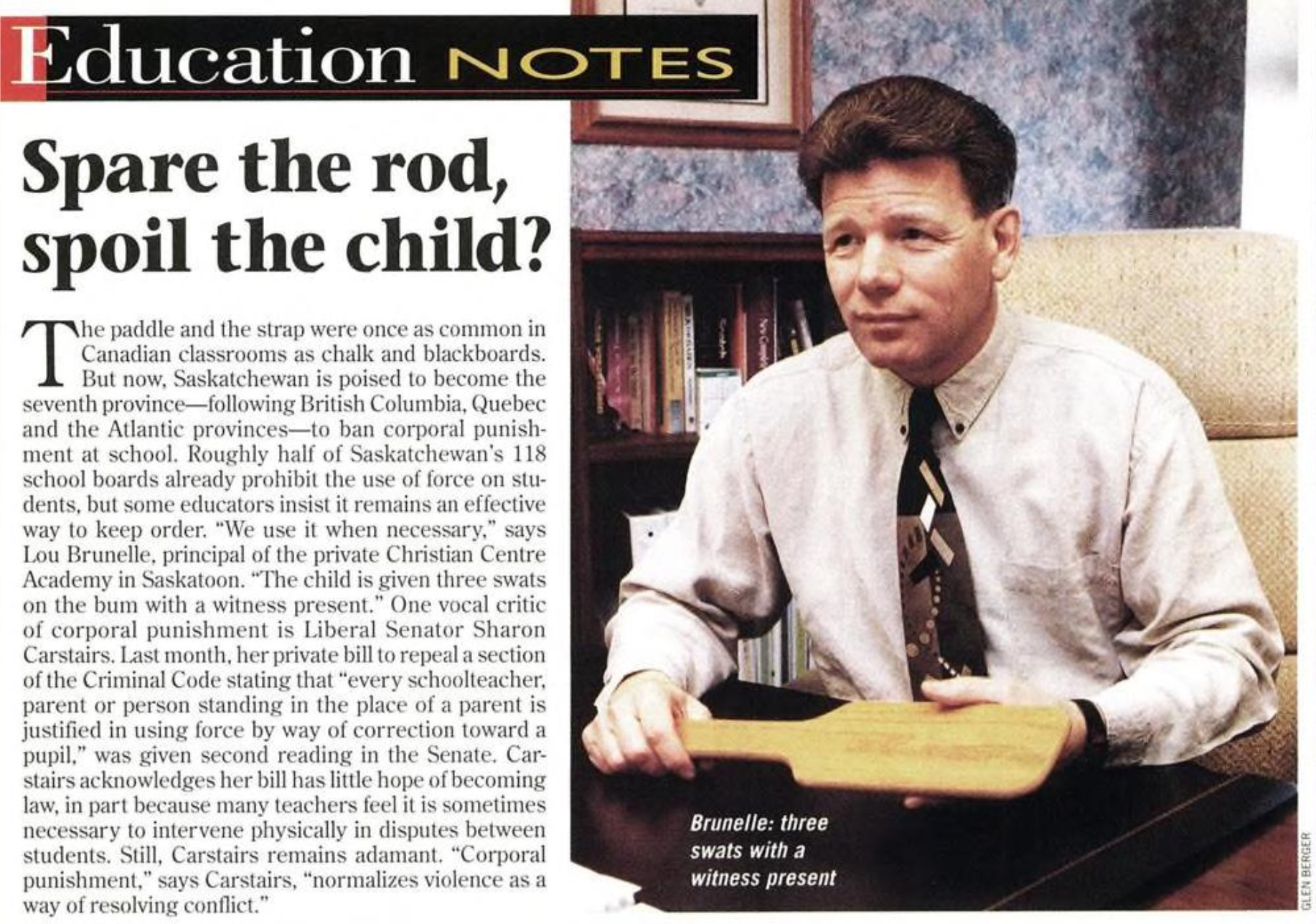
In the March 10, 1997 edition of Macleans’ magazine, Brunelle is pictured holding a wooden paddle. He is identified as the principal of the then-Christian Centre Academy and is responding to a bill put forward by former Senator Sharon Carstairs calling for an end to child physical punishment and the fact that Saskatchewan was poised to end corporal punishment in schools. He is quoted as saying that in his school (CCA) “we use (the wooden paddle) when necessary … the child is given three swats on the bum with a witness present.”
For many observers and former students, the photograph has taken on symbolic weight. It represents how disciplinary practices, including corporal punishment, were not treated as controversial or exceptional within the institution, but as normalized tools of correction embedded within its broader religious and educational philosophy. The paddle, in that sense, was not just an instrument of discipline. It functioned as a visible extension of the system’s authority, linking physical punishment to the same framework of obedience and spiritual compliance that shaped the rest of student life.
The fact that such an image appeared in a national publication also highlights how these practices were, at least at times, publicly acknowledged rather than concealed. For critics, it reinforced concerns about the institutional acceptance of corporal punishment within a setting where questioning authority was already constrained. For former students, it has often stood as a stark visual reminder of how discipline was justified, framed, and, in their accounts, experienced.
A recurring theme in these accounts is the role of silence and normalization. Former students describe environments where such disciplinary practices were either accepted as standard or difficult to challenge, particularly when framed within a religious or moral context that emphasized obedience and correction. This dynamic, they say, made it harder to question the practice or seek outside help.
In total, at least 18 former students have filed criminal complaints alleging physical assault related to these disciplinary practices. These complaints have contributed to broader police investigations and civil legal proceedings examining the school’s historical use of corporal punishment and the boundaries between discipline and abuse.

The Podcast
The Legacy of Abuse Podcast
The Legacy of Abuse Podcast shares powerful firsthand stories and tracks the ongoing fight for truth, accountability, and justice surrounding institutional abuse at Legacy Christian Academy, Christian Centre Academy, Saskatoon Christian Centre, & Mile Two Church.
Isolation and psychological control
Former students describe a broader system of control that extended beyond formal discipline into everyday behaviour, communication, and identity. In these accounts, isolation was not only physical separation in the classroom, but also a social pattern that limited normal peer connection and reinforced dependence on authority structures within the school and church environment. Over time, this reportedly created an atmosphere where students were cautious about how they interacted with others, aware that relationships and conversations could be observed or interpreted through a disciplinary lens.
Surveillance, as described in these accounts, was not necessarily technological but relational and institutional. Teachers, supervisors, and church-linked staff were said to monitor behaviour closely throughout the day, with attention given not only to academic performance but also to tone, posture, and perceived attitude. Students report that this level of observation contributed to a persistent sense of being evaluated, where even ordinary actions could carry unintended consequences depending on how they were interpreted by authority figures.
Questioning authority is another recurring theme in these descriptions. Former students allege that expressing doubt, challenging instructions, or resisting expectations could result in disciplinary responses or increased scrutiny. In some cases, they describe learning to self-censor early, anticipating consequences before speaking or acting. This dynamic, they say, reinforced a culture where compliance was safer than curiosity, and where uncertainty about boundaries encouraged silence rather than dialogue.
Expectations around conformity extended beyond behaviour into appearance and communication. Students report prescribed standards for dress (dress code), language, and conduct that aligned with the school’s religious and cultural framework. Deviation from these expectations could draw correction or correctional attention, reinforcing the importance of outward conformity as a measure of belonging and acceptance within the community.
Taken together, some former students characterize these combined elements – restricted social interaction, constant observation, enforced conformity, and consequences for dissent – as forming a psychologically coercive environment. While experiences varied among individuals and time periods, the overall description points to a system where authority shaped not only actions but also how students were encouraged to think, speak, and relate to others.
Allegations of extreme isolation
In accounts published by Mark Drapak, he describes being sent as a teenager to Canaan Land, a remote Bible training centre near Big River, Saskatchewan, after being removed from his regular school environment at Christian Centre Academy and placed under the direction of church and school leadership. He recalls the transition not as a voluntary decision, but as something presented through authority structures tied to the church community, where refusal was not meaningfully framed as an option.

Mark Drapak was sent to an isolated ‘bible training centre’ called ‘Canaan Land’ when he was a student at Christian Centre Academy
Drapak has described Canaan Land as a highly controlled and isolating environment. Daily life was structured around strict routines, limited personal freedom, and close supervision, with rules governing communication, movement, and interaction with the outside world. Contact with family was restricted, and outside media and social connection were heavily controlled, contributing to a sense of separation from normal adolescent life.
He has characterized the experience as coercive in nature, emphasizing how religious authority, institutional pressure, and physical isolation worked together to enforce compliance. In his account, the combination of spiritual framing and restricted autonomy created an environment where obedience was expected and dissent was difficult, shaping how he later understood his time there and its lasting impact.
Allegations of “exorcism-style” incidents
Allegations of so-called “exorcism-style” incidents are among the most serious and sensitive accounts shared by former students. They describe situations where disciplinary or pastoral interventions were framed in explicitly spiritual terms, where behaviour, identity, or personal struggles were treated not only as issues of conduct but as signs of spiritual conflict requiring intervention.
Former students report being placed in structured prayer sessions or intensive group settings led by authority figures or church-associated individuals. These sessions are described as emotionally charged environments involving prolonged prayer, confession, and repeated spiritual declarations. Some accounts also reference speaking in tongues and coordinated group prayer directed at an individual. Those who experienced these situations often describe them as overwhelming and disorienting, with strong pressure to participate and conform to what was expected within the setting.
A particularly serious set of allegations involves claims that certain interventions were directed at students based on personal identity, including sexual orientation. In one widely reported case, a former student alleged being subjected to a religious intervention that was framed as an attempt to address or remove what was described in spiritual terms related to being gay. According to the account, the experience involved sustained religious pressure and was perceived by the student as coercive and deeply distressing.

Coy Nolin says he’s still scarred by the abuse he suffered while attending Saskatoon’s Christian Centre Academy, now called Legacy Christian Academy, but he is now proud of his identity and finding ways to heal.
These allegations form part of broader legal and investigative processes involving the school and its affiliated church network. While not all claims have been proven in court, they have been included in police investigations and civil proceedings, contributing to ongoing examination of how religious authority and disciplinary practices may have intersected in certain reported cases.
Taken together, these accounts describe situations where religious belief and institutional discipline were closely intertwined, raising complex questions in legal and public discourse about boundaries between religious practice, coercion, and institutional responsibility.
Allegations and proven instances of sexual assault
A recurring theme emerging from survivor accounts and public reporting is the sense of institutional patterning of sexual assault rather than isolated incidents. Allegations and proven court cases across different time periods describe sexual abuse occurring within the same interconnected church and school environment. Former students have also pointed to concerns about how leadership responded when issues were raised, describing repeated failures to intervene and a culture where questioning authority was discouraged. These accounts have contributed to a broader narrative of systemic harm rather than singular events, reinforcing questions about oversight, accountability, and continuity across decades within the same institutional network.
Aaron Travis Benneweis, a 47-year-old former teacher and athletic director at Legacy Christian Academy in Saskatoon, was sentenced on January 18, 2024, to two years less a day in jail followed by three years of probation. He pleaded guilty to sexual assault and sexual exploitation of a student, Jennifer Beaudry, whom he groomed and assaulted in seven separate incidents between 2008 and 2012 when she was aged 13 to 16. As her gym teacher and track coach, Benneweis took her to secluded locations or empty school rooms where he kissed and groped her. The judge noted the grooming occurred in the insular Christian school environment that emphasized obedience to authority and lacked proper boundaries or sex education.

Jennifer Beaudry
The judge criticized Benneweis for knowingly continuing the abuse and highlighted the school’s attempted cover-up, including pressuring the victim to lie to police. Beaudry described the long-term damage to her self-worth and trust in her victim impact statement. This case is linked to broader allegations of abuse at the school and associated church.
Three women who attended a Saskatoon private Christian school and its affiliated church allege they were sexually abused in the 1990s by Sunday school teacher Nathan Schultz when they were between the ages of four and seven. They say the abuse occurred in the church and school building and describe it as involving grooming, coercion, and repeated incidents that left lasting psychological harm. The women are among plaintiffs in a proposed $25-million class-action lawsuit that alleges widespread abuse and cover-up at the institution, then known as Christian Centre Academy and Saskatoon Christian Centre, now operating under the names Legacy Christian Academy and Mile Two Church.

Caitlin Erickson
The lawsuit also names multiple other individuals, including Schultz’s parents, who held leadership roles in the church and school at the time. Plaintiffs allege that officials were informed of abuse concerns multiple times but failed to act appropriately, and in some cases discouraged reporting. One woman says she was reprimanded and threatened after disclosing concerns about Schultz, which contributed to a culture of silence and fear.
Legal aftermath and investigations
The allegations connected to the school have led to a wide range of legal and institutional responses over time. Police have opened investigations into historical abuse claims based on complaints from former students, many of which involve events said to have occurred years or even decades earlier. These investigations have included interviews, evidence gathering, and review of historical records as authorities attempt to assess patterns of alleged conduct within the school and its affiliated church network.
In some cases, these investigations have resulted in criminal charges being laid against former staff or individuals connected to the institution. Court proceedings in these matters have moved through the justice system independently, with outcomes varying depending on the specific charges and evidence presented. Some cases remain ongoing or have been resolved through legal processes that continue to be referenced in public reporting and civil actions.
Alongside criminal proceedings, there is also a proposed $25-million class-action lawsuit involving a large number of former students. This legal action seeks to examine whether there was systemic wrongdoing or institutional responsibility related to the experiences described in the allegations. The class-action process is ongoing, and its outcomes have not yet fully resolved all claims, but it reflects the collective nature of the complaints being brought forward.
Over time, several related court cases have reached conclusions, including guilty rulings in specific instances. Some of these cases have also resulted in prison sentences for individuals found responsible under the law. These outcomes are distinct from the broader set of allegations and relate to specific charges that were tested in court.
Beyond the legal system, former students frequently describe long-term personal impacts that continue into adulthood. Many report ongoing fear or anxiety when dealing with authority figures, especially in structured environments such as schools, workplaces, or institutions. Others describe difficulty trusting organizations or systems of authority, particularly those connected to religion or education. Emotional distress is also commonly reported when recalling experiences from their time at the school, suggesting that the impact of those years can remain present long after leaving the environment.
Some former students describe moving away from organized religion entirely as a result of their experiences, while still maintaining personal belief or spirituality outside of institutional structures. Others describe a more complex internal balance, where they continue to hold personal faith while also rejecting the specific practices, leadership, or environment they associate with the school and church system.
Taken together, these accounts reflect not only legal and criminal consequences that have emerged over time, but also a wide spectrum of personal outcomes that continue to shape how former students relate to authority, religion, and community in their adult lives.
A change in identity but not practice
The pattern of reinvention extended beyond the school itself to the church it was historically tied to. The Saskatoon Christian Centre first rebranded as Mile Two Church, before later again renaming to Encounter Church. Each transition introduced a new name and visual identity, while the organization continued operating in the same location. The progression of names suggests a change in branding rather than a clear break in practice, with former students and observers pointing to continued patterns that remained closely connected to the institution’s earlier identity.

Saskatoon Christian Centre later renamed themselves to Mile Two Church
The school followed a similar path. After renaming to Legacy Christian Academy, it was later again renamed Valour Academy, marking another step in its evolving identity. Each rebrand subtly reframed how the institution presented itself, emphasizing new language while still casting doubt on their internal changes. Many ask if it was just a slap of new paint on old rot.

Christian Centre Academy renamed themselves to Legacy Christian Academy in 2013.
Taken together, these parallel rebrandings form a kind of institutional reset narrative, where both church and school have sought to redefine themselves in the public eye. For the church-school, these changes are intended to present an effort to turn a page. For others, they raise ongoing questions about continuity, accountability, and whether a sequence of new names can fully separate present-day institutions from the histories rooted in the same place and community.
The broader picture
What emerges from documented reporting is not a single, uniform narrative but a convergence of multiple testimonies and legal records that point to a shared set of themes across different time periods and individuals. While experiences vary and not every account describes the same events in the same way, there is a consistent pattern in how former students and investigations characterize the structure and culture of the school environment.
One of the most frequently described elements is a highly authoritarian school and church structure. In these accounts, authority was centralized and strongly enforced through rules, discipline, and close supervision of student behaviour. Many former students describe a system where compliance was expected not only in academic work but also in conduct, communication, and interaction with authority figures.
Another recurring theme is the strong integration of church leadership into the educational environment. Reporting and testimony describe a setting where church and school were closely linked, with shared values, leadership influence, and overlapping expectations. This integration is often described as shaping both daily routines and broader behavioural standards, with religious doctrine influencing how discipline and instruction were applied.
Corporal punishment practices are also a major component of the documented allegations. Former students and legal filings describe the use of physical discipline in response to a range of behavioural, academic, and other issues. These accounts have been part of police investigations and court proceedings, and in some cases have contributed to criminal charges and legal outcomes involving individuals connected to the institution.
In addition, there are allegations of psychological and spiritual coercion. These include descriptions of intense disciplinary environments, pressure to conform to strict behavioural expectations, and religiously framed interventions. While these accounts differ in detail, they are often grouped together in reporting due to their shared emphasis on control, conformity, and authority within both educational and spiritual contexts.
The situation has also been subject to ongoing legal and criminal scrutiny. This includes police investigations into historical allegations, civil litigation, and court proceedings that have developed over time. Some cases have resulted in formal legal findings, while others remain active or unresolved, reflecting the complexity and duration of the processes involved.
At the same time, the institution has issued public statements addressing the allegations. These statements have included claims that many individuals named in complaints are no longer affiliated with the school or its current operations. This response has been part of the broader public record as the institution seeks to distinguish its present-day structure from past conduct described in historical allegations.
Taken together, the documented reporting presents a layered picture that includes both serious allegations under investigation and legal review, as well as institutional responses that minimize past concerns while emphasizing their trivial changes in personnel and oversight.
Today, the private school remains open. It receives public funding to operate, in addition to charging tuition.
Ex-‘Pastor’ Keith Johnson is actively evading the civil legal system in a $25-million class-action lawsuit alleging horrific abuses and harms.
Some Interesting Details
Join the class-action lawsuit
Scharfstein LLP are representing the claimants
The Statement of Claim was issued on August 8, 2022. The next step will be collecting information, and certification of the claim as a class action on behalf of all minors who attended Legacy Christian Academy, Christian Centre Academy, Saskatoon Christian Centre, and/or Mile Two Church from 1982 to present.